


 CLSK
CLSK
 CORZ
CORZ
 HUT
HUT IREN
IREN
 WULF
WULFDilution, explained with two miners' own share counts
What a rising share count does to what you own, worked through CleanSpark's and  MARA's filed share counts, an at-the-market program and a convertible note.
Written by Dean Shalem, published , about 9 minutes to read.
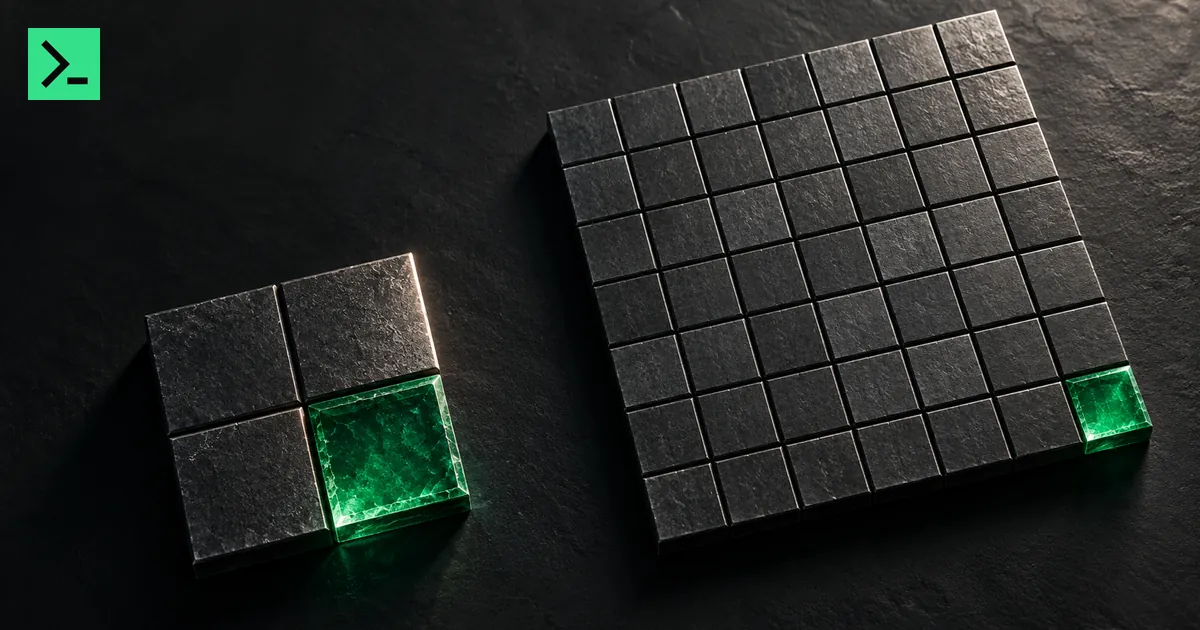
Dilution is a fraction getting a bigger denominator.
A share is a claim on a company. Your claim is your shares divided by all the shares that exist. That fraction is your ownership. Dilution is what happens to the fraction when the company creates more shares and you do not buy any of them.
Say a company has 100 shares and you hold one. You own 1 percent. It creates 20 more shares and sells them to someone else. Now 120 shares exist and you still hold one. You own 0.83 percent. Nobody took anything from you. Your share is the same piece of paper. The company is simply split into more pieces.
Two things matter after that, and they are separate questions. First, how much did your fraction shrink? Second, did the company get enough for the new shares to make up for it?
The fraction question has one formula.
Your ownership after a raise, as a share of your ownership before it, is the old share count divided by the new one.
| 100,000 | 1.000 percent | 1.00 |
|---|---|---|
| 120,000 | 0.833 percent | 0.83 |
| 200,000 | 0.500 percent | 0.50 |
| 1,000,000 | 0.100 percent | 0.10 |
Notice the first jump. A 20 percent rise in the count is a 17 percent fall in ownership, not 20. Doubling the count halves ownership. Multiplying the count by ten leaves a tenth. The percentages are not symmetric, which is why the two companies below are easier to read as ratios than as percentages.
CleanSpark's count went up eleven-fold and then down. MARA's went up every year.
Both companies report their share count in every quarterly and annual filing, and the SEC publishes the figures as data. The table takes the last reported count in each calendar year. The count itself is the fact; the ratios are arithmetic on it.
| Dec 31, 2020 | 24,070,531 | 1.00 | 81,974,619 | 1.00 |
|---|---|---|---|---|
| Dec 31, 2021 | 41,474,062 | 1.72 | 102,733,273 | 1.25 |
| Dec 31, 2022 | 71,743,930 | 2.98 | 145,565,916 | 1.78 |
| Dec 31, 2023 | 185,554,611 | 7.71 | 242,829,391 | 2.96 |
| Dec 31, 2024 | 280,806,295 | 11.67 | 340,258,453 | 4.15 |
| Dec 31, 2025 | 255,749,498 | 10.62 | 379,464,892 | 4.63 |
| 10-Q cover page | 256,817,073 (Aug 4, 2026) | 10.67 | 386,299,297 (Jul 30, 2026) | 4.71 |
Read CleanSpark first. From the end of 2020 to the end of 2024 the count rose from 24.1 million to 280.8 million. Divide the two: 11.67. A holder who bought 1,000 shares at the end of 2020 and never bought again owned 1,000 divided by 24,070,531, which is 0.00415 percent. At the end of 2024 the same 1,000 shares were 1,000 divided by 280,806,295, which is 0.00036 percent. The fraction is 8.6 percent of what it was. Ownership fell 91.4 percent in four years.
Then it stopped. At the end of 2025 CleanSpark reported 255,749,498 shares, down 25,056,797 from a year earlier. That is a fall of 8.9 percent, the first yearly fall in the series. The company's own words for that year, in its fiscal 2025 results, were that it chose "convertible debt and bitcoin backed revolvers instead of an ATM to finance the business during the calendar year". The next article explains each of those tools. Here the point is only what the count did.
MARA tells a steadier story. The count rose every single year: 25 percent, then 42 percent, then 67 percent, then 40 percent, then 12 percent. A 2020 holder of 1,000 shares owned 0.00122 percent then and 0.00026 percent at the end of 2025. The fraction is 21.6 percent of what it was, so ownership fell 78.4 percent over five years. That is a smaller fall than CleanSpark's over the same period, but it has not stopped: from the end of 2025 to the Jul 30, 2026 cover-page count the number rose another 1.8 percent.
Neither ratio says anything about whether holders did well. That needs the second question.
The value question asks what the new shares bought.
Go back to the 100-share company. Suppose it is worth $1,000 in total, so each share is worth $10. It sells 20 new shares. The count rises 20 percent in every case below. What happens to the value of one old share depends only on the price the new shares were sold for.
| $12 | $240 | $1,240 | $10.33 | better off |
|---|---|---|---|---|
| $10 | $200 | $1,200 | $10.00 | unchanged |
| $8 | $160 | $1,160 | $9.67 | worse off |
In all three rows the holder's ownership fell from 1 percent to 0.83 percent. In only one row did the holder lose value. That is why the site's specification separates the share count from what it calls accretive dilution: a raise is accretive when each dollar raised is turned into more than a dollar of value per share. Selling shares above what they are worth is one way. Buying machines or bitcoin that turn out to be worth more than they cost is the other, and that one is only known later.
The table simplifies one thing. A company is not worth its cash. It is worth what buyers will pay for its future, and that number moves every day. The arithmetic still holds: the count is a fact from the filing, the price is a fact from the market, and what the money became is the thing to watch.
An at-the-market program moves the count a little at a time.
An at-the-market program, called an ATM, is a standing permission to sell new shares into the ordinary market through a bank, at whatever the price is that day, up to a dollar ceiling. There is no announced deal and no discount. The shares appear in the share count of the quarterly filing that follows the sale.
On Mar 28, 2025 MARA filed a prospectus supplement for an at-the-market offering of up to $2,000,000,000. CleanSpark had filed one on Mar 28, 2024 for up to $800,000,000. The dollar ceiling is the fact. How many shares it becomes depends on the price when each share is sold, so the worked example has to pick a price and label it as a guess.
| $10 | 200,000,000 | 540,258,453 | 58.8 percent | 0.63 |
|---|---|---|---|---|
| $15 | 133,333,333 | 473,591,786 | 39.2 percent | 0.72 |
| $25 | 80,000,000 | 420,258,453 | 23.5 percent | 0.81 |
Rise in MARA's share count
Against its 2024 year-end count, with its 2.0 billion dollar at-the-market ceiling fully sold.
Method and sources
The same 2.0 billion dollar ceiling raises the count by 59 percent at 10 dollars a share and by 24 percent at 25.
- Covers
- arithmetic on the 424B5 ceiling and the 340,258,453 count at Dec 31, 2024
- Unit
- percent of the 2024 year-end count
Source: MARA 424B5 Mar 28, 2025
| Average sale price | Rise in share count (percent of the 2024 year-end count) |
|---|---|
| $10 a share | +58.8% |
| $15 a share | +39.2% |
| $25 a share | +23.5% |
The same $2.0 billion costs a holder a third of their fraction at $10 a share and a fifth of it at $25. A higher share price makes every raise cheaper for existing holders, which is why companies tend to sell when the price is up. Whether the program is used at all, and how far, is reported each quarter; the profile page shows what each filing says about the program and any remaining capacity it states.
A convertible note moves the count later, and only if the price cooperates.
A convertible note is a loan that the lender can swap for shares at a fixed price. Until it is swapped, the count does not move. If the stock never reaches the swap price, the company pays the loan back in cash and the count never moves. If the stock rises past it, the lender converts and the new shares arrive all at once.
On Oct 29, 2025 TeraWulf priced $900 million of 0.00 percent convertible senior notes due 2032. Each $1,000 of notes converts into 50.1567 shares, an initial conversion price of about $19.9375, which was 37.5 percent above the $14.50 closing price that day. The coupon is zero: the company pays no interest, and the lender is paid instead by the chance to convert.
| Item | Figure |
|---|---|
| Notes | $900,000,000 |
| Shares per $1,000 | 50.1567 |
| Shares if fully converted | 45,141,030 |
| Count at Jul 31, 2026 | 498,968,677 |
| Rise in count if converted | 9.0 percent |
| Ownership after, as a share of before | 0.917 |
Two things follow for a shareholder. The dilution is capped and known in advance: at most 45.1 million shares, and only if the stock is above $19.94. And it only happens when the stock has risen, so the new shares are sold, in effect, at a price 37.5 percent above where the stock stood when the money arrived. The trade is that the loan has to be repaid in 2032 if the price does not get there, and $900 million of cash going out is a different kind of risk from a smaller fraction.
Check any company in three steps.
- Open the company's profile on this site and find the share-count series. Divide the count at the date you are measuring to by the count from the date you bought. That is the denominator of your ownership, and one divided by it is what is left of your fraction.
- Open the company's 424B5 and 10-Q for the date you are measuring to and find the at-the-market ceiling and any convertible note. Divide the note by $1,000 and multiply by its shares per $1,000 for the most shares it can add.
- Ask what the money became. Hashrate, bitcoin held and revenue per share are on the profile. If they rose faster than the count, the raise was accretive by the site's definition. If they did not, the count rose and nothing else did.
The next article, how miners raise money, takes each instrument in turn.
Sources
- CleanSpark, CommonStockSharesOutstanding, every filing (SEC XBRL company concept, CIK 827876) Year-end counts read Sep 6, 2026; the same series is charted on this site.
- MARA Holdings, CommonStockSharesOutstanding, every filing (SEC XBRL company concept, CIK 1507605) Year-end counts read Sep 6, 2026.
- CleanSpark 10-Q filed Feb 5, 2026 (the 255,749,498 count at Dec 31, 2025)
- CleanSpark 10-Q filed Feb 6, 2025 (the 280,806,295 count at Dec 31, 2024)
- CleanSpark 10-Q filed Aug 6, 2026 (the 256,817,073 cover-page count at Aug 4, 2026)
- MARA 10-Q filed Aug 6, 2026 (the 379,464,892 count at Dec 31, 2025 and 386,299,297 at Jul 30, 2026)
- MARA prospectus supplement, 424B5 filed Mar 28, 2025: at-the-market offering of up to $2,000,000,000
- CleanSpark prospectus supplement, 424B5 filed Mar 28, 2024: at-the-market offering of up to $800,000,000
- CleanSpark fiscal 2025 results, 8-K exhibit 99.1 filed Nov 25, 2025 (the chairman's sentence on convertible debt and bitcoin-backed revolvers instead of an ATM)
- TeraWulf pricing release, 8-K exhibit 99.1 filed Oct 30, 2025: $900 million 0.00% convertible senior notes due 2032, 50.1567 shares per $1,000
- TeraWulf, EntityCommonStockSharesOutstanding (SEC XBRL company concept, CIK 1083301): 498,968,677 shares at Jul 31, 2026
Run the same figures on any company: the share-count series on any company profile.