


 CLSK

 CORZ

 HUT
 WULF
What it costs to mine a bitcoin, and what a cost figure leaves out
Compare direct cost and cost with depreciation. See what CleanSpark,  Riot and TeraWulf include, how each cost compares with bitcoin earned, and why officer pay is excluded. Includes an interactive power-to-bitcoin example.
Written by Dean Shalem, published , about 8 minutes to read.
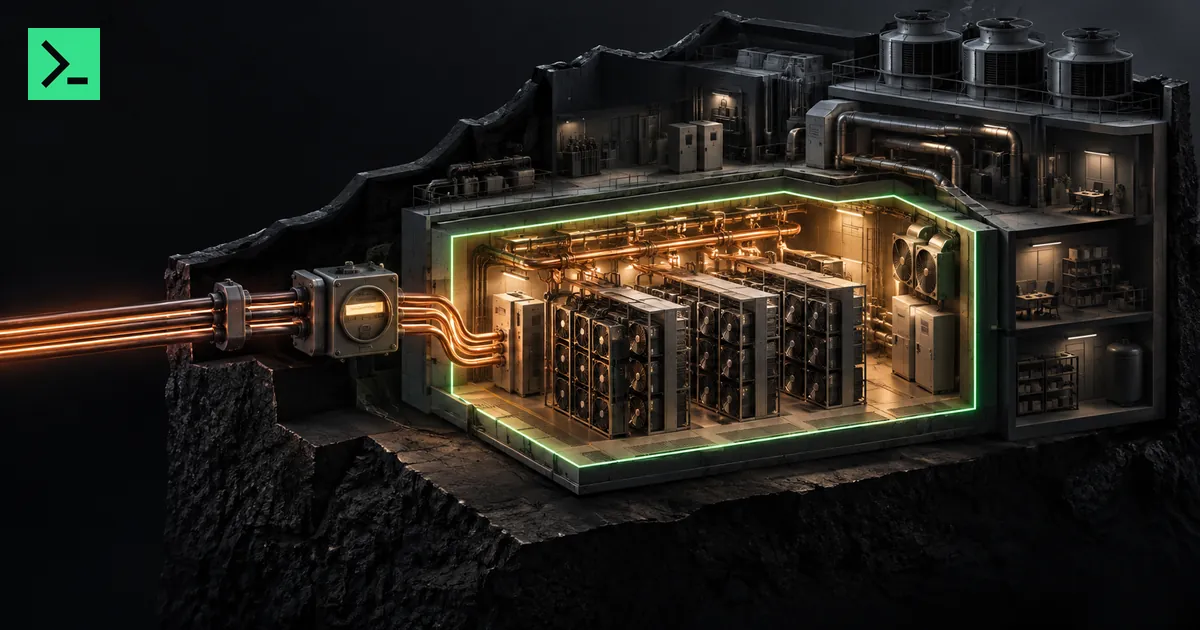
A miner reports two costs, and they answer different questions.
A bitcoin miner turns electricity into bitcoin. The first cost anyone asks about is the electricity, and every miner on file that states a cost per bitcoin states this one: the power bill, plus the other direct costs the company counts, divided by the bitcoin mined in the period. On this site that is the direct cost per bitcoin. It answers one question: what did it cost, in cash, to keep the machines running for each coin.
The second cost adds the wear on the machines, which the first leaves out, and it answers a different question: what did the coin cost once depreciation is counted. The trouble is that each company decides what else to add. One names financing costs as well. None of the figures with depreciation that companies publish adds the salaries of the people who run the company. So such a figure is only readable next to its definition, which is why the table below carries each company's own words.
This site also keeps a definition of its own, on the methodology page, and calls it all-in: mining costs plus payroll, general and administrative expense and depreciation, divided by bitcoin mined. No company on file reports that figure. Every cost with depreciation below is the company's own, marked as such.
Follow the power bill through to bitcoin and cash.
Illustrative inputs, set on Sep 23, 2026. These are not current network data or a company forecast. Change one input and follow its effect through the chain.
1. Power
100 MW
2. Hashrate
4.5 EH/s average
3. Bitcoin
2.0898 BTC/day expected
4. Cash left after power
100,980 USD/day
Daily revenue: $208,980. Electricity: $108,000. The remainder still has to pay every other cost.
The example assumes 144 blocks per day after difficulty adjustment, 0.1 BTC of fees per block, constant network share and no pool fee. It excludes cooling and other site power, curtailment credits, payroll, repairs, capital expenditure, debt, tax and working capital. The final step is a cash contribution after electricity, not free cash flow. Real output varies with pool terms and luck.
What each company puts inside its figure.
Of the six miners compared here, three publish a cost per bitcoin with depreciation. Here is each one, with the period it covers and what the filing says it includes and excludes.
| What the cost with depreciation includes and leaves out | ||||
|---|---|---|---|---|
| CleanSpark | Quarter ended Jun 30, 2026 | 44,406 | 96,277 | Adds non-cash depreciation and financing costs (none in the quarter ended Jun 30, 2026); miner depreciation alone is 51,871 of it. Leaves out SG&A. |
| Riot | Quarter ended Jun 30, 2026 | 49,912 | 90,631 | Both costs are net of 10.1 million of power curtailment credits. Leaves out SG&A. |
| TeraWulf | Quarter ended Jun 30, 2026 | 44,547 | 97,486 | Energy is 44,402 of the direct figure, net of expected demand response proceeds, for the Lake Mariner Data Campus alone. Adds 52,939 of depreciation, which the 10-Q gives in a footnote. Leaves out SG&A and interest. |
Three things to notice. The direct figures sit within about 6,000 dollars of each other. The figures with depreciation sit within about 7,000 dollars of each other, but that is partly coincidence, because they do not include the same things. And every one of them leaves out SG&A, which matters for the last section of this article.
The other three publish a direct cost and no cost with depreciation: MARA, IREN and American Bitcoin, the listed mining subsidiary of Hut 8. Hut 8 itself states no cost per bitcoin, so the 36,500 below is American Bitcoin's figure and not Hut 8's. Each one defines even the direct figure a little differently, and the filing says how.
| How the company defines it | |||
|---|---|---|---|
 MARA | Quarter ended Jun 30, 2026 | 38,690 | The amounts paid to power providers for power consumed, at owned sites; third-party hosting and other energy costs are a separate line and are not in it. |
| American Bitcoin, a Hut 8 subsidiary | Quarter ended Jun 30, 2026 | 36,500 | Hut 8 itself states no cost per bitcoin. American Bitcoin's release does not define its figure; its 10-Q puts cost of revenue before depreciation at $34.0 million over about 932 bitcoin mined, which is about the same, and says all its miners sit at Hut 8's facilities, where Hut 8 billed it colocation and management fees. |
 IREN | Quarter ended Dec 31, 2025 | 34,400 | Net electricity costs per bitcoin mined: electricity after demand response income, plus the program's fees, for bitcoin mining only; the company prints it in thousands of dollars, as 34.4. |
Cost per bitcoin by company
Five miners, direct and with depreciation, as each company states them.
Method and sources
For each of the three companies that state both, the figure with depreciation is the larger.
IREN's direct figure is for the quarter ended Dec 31, 2025, so it is not drawn here, where every bar is for the quarter ended Jun 30, 2026. It is in the table above. MARA's direct figure counts the power bill alone. The bars are not adjusted to one definition and are not ranked.
- Covers
- quarter ended Jun 30, 2026 for every bar, each on its company's own definition
- Unit
- USD per bitcoin
Source: the filings in Sources 1 to 6
| Company | Direct, quarter ended Jun 30, 2026 (USD per bitcoin) | With depreciation, quarter ended Jun 30, 2026 (USD per bitcoin) |
|---|---|---|
| CleanSpark | $44,406 | $96,277 |
| Riot | $49,912 | $90,631 |
| TeraWulf | $44,547 | $97,486 |
| MARA | $38,690 | |
| American Bitcoin, a Hut 8 subsidiary | $36,500 |
A gap where a bar would be means the company publishes no cost with depreciation. The bars are the companies' own numbers and are not adjusted to one definition; the table above says what each includes.
Set each cost against the bitcoin the company earned.
A cost per bitcoin means something only against what a bitcoin brought in during the same period. All three companies state that figure in the same filing: CleanSpark's average revenue per bitcoin mined was 71,692 dollars in its quarter, Riot's production value was 71,667 dollars per bitcoin mined in its quarter, and TeraWulf's 10-Q prints the value of each bitcoin mined at 71,704 dollars for the quarter.
| CleanSpark | 71,692 | 61.9 percent | 134.3 percent |
|---|---|---|---|
| Riot | 71,667 | 69.6 percent | 126.5 percent |
| TeraWulf | 71,704 | 62.1 percent | 136.0 percent |
Cost and revenue per bitcoin
CleanSpark and Riot, for one quarter, as filed.
Method and sources
On the direct cost alone each bitcoin cost less than it brought in. With depreciation added it cost more.
- Covers
- quarter ended Jun 30, 2026
- Unit
- USD per bitcoin
Source: CleanSpark 10-Q Aug 6, 2026 and Riot 8-K Aug 10, 2026
| Company | Direct cost (USD per bitcoin) | Cost with depreciation (USD per bitcoin) | Revenue per bitcoin mined (USD per bitcoin) |
|---|---|---|---|
| CleanSpark | $44,406 | $96,277 | $71,692 |
| Riot | $49,912 | $90,631 | $71,667 |
Read the CleanSpark row. On the direct cost alone, each bitcoin cost about 62 percent of what it brought in: a cash margin. Once the wear on the machines is added, each bitcoin cost 134 percent of what it brought in: a loss, on that basis, of about 24,600 dollars a coin. Both statements are true at once, and they describe different things. The first is the cash the quarter produced. The second is what is left after the machines that produced it are being paid for.
So the answer to "is this company mining at a loss?" is: on which basis, in which period. In the quarter ended Jun 30, 2026, CleanSpark's direct cost was below its revenue per bitcoin mined and its cost with depreciation was above it. Riot reads the same way. Neither figure says anything about a later quarter, because both move with the bitcoin price, the network's total hashrate, and the company's own machines.
Where the salaries are, and why cutting them would not move these figures.
Officer pay is booked in selling, general and administrative expense, SG&A, and every cost with depreciation on file leaves SG&A out. That means the question "what would the cost per bitcoin be if the team paid itself less?" has a plain answer for these three companies: it would be exactly the same. The pay is not in the number. What would move is net income, which is where SG&A lands.
The pay is not small. CleanSpark's proxy lists five named executive officers whose 2025 totals, as printed in its Summary Compensation Table, add to about 133 million dollars, most of it stock awards. None of that is in the 96,277 dollars. Under this site's own definition, which adds payroll and general and administrative expense, it would be, and the cost per bitcoin would read higher than the company's figure by however many bitcoin that year's payroll is spread across.
That is the practical use of knowing the definition. A company that reports a low cost per bitcoin has not necessarily got low costs; it may have drawn the line around a narrower set of them. The people page for each company lists what each officer was paid, year by year, so the amount left outside the cost figure is always one click from it.
Sources
- CleanSpark 10-Q for the quarter ended Jun 30, 2026, filed Aug 6, 2026: cost to mine one bitcoin, direct energy cost $44,406; including non-cash depreciation and financing costs $96,277 (owned facilities); average revenue per bitcoin mined $71,692 The prior-year quarter: $44,806 and $86,428.
- Riot Platforms Q2 2026 results, 8-K exhibit 99.1 filed Aug 10, 2026: cost to mine excluding depreciation $49,912, net of $10.1 million of power curtailment credits; including depreciation $90,631, 126.5% of production value of $71,667 per bitcoin mined
- TeraWulf 10-Q for the quarter ended Jun 30, 2026, filed Aug 5, 2026: cost to mine one bitcoin $44,547 (energy cost $44,402 and other direct cost $145 per bitcoin) at the Lake Mariner Data Campus, a cash cost before depreciation; with the $52,939 of depreciation that a footnote adds, $97,486; value of each bitcoin mined $71,704, and the cost to mine one bitcoin as 62.1 percent of it
- MARA Q2 2026 shareholder letter, 8-K exhibit 99.1 filed Aug 6, 2026: purchased energy of $38,690 per bitcoin at owned sites; third-party hosting and other energy costs of $69.2 million, a separate line not expressed per bitcoin
- MARA 10-Q for the quarter ended Jun 30, 2026, filed Aug 6, 2026: purchased energy costs per BTC of $38,690 in the owned facilities statistics, with 1,260 bitcoin produced at owned facilities
- American Bitcoin Q2 2026 results, 8-K exhibit 99.1 filed Aug 3, 2026 (Hut 8's listed mining subsidiary): cost to mine about $36,500 per bitcoin in Q2 2026 against about $36,200 in Q1 2026 The release does not define the figure.
- American Bitcoin 10-Q for the quarter ended Jun 30, 2026, filed Aug 3, 2026: cost of revenue, before depreciation and amortization, of $34.0 million, with about 932 Bitcoin mined; all of its miners are at Hut 8's facilities, and Hut 8 billed it $31.7 million under the colocation agreement and $3.4 million under the management agreement for the quarter $34.0 million over 932 comes to about $36,500, the figure the release gives.
- IREN 10-Q for the quarter ended Dec 31, 2025, filed Feb 5, 2026: net electricity costs per bitcoin mined, 34.4 thousand dollars for the three months and 35.0 thousand for the six months The 10-Q for Sep 30, 2025 prints 35.4 thousand; the 10-Q for Mar 31, 2026 and the 10-K for fiscal 2026 do not print the figure.
- CleanSpark proxy statement, DEF 14A filed Jan 22, 2026: the Summary Compensation Table, 2025 totals for the five named executive officers The five totals are on this site's people page for CleanSpark.
- MinerTerminal methodology, section 2: the site's own all-in definition (Method B) and direct definition (Method A)
Run the same figures on any company: the cost brief on the Companies page.